
Many women blame themselves for feeling shaky between meals, crashing in the afternoon, or constantly thinking about food. They’re told to “eat less sugar,” “try fasting,” or “have more willpower.” But blood sugar regulation is not a discipline issue—it’s a mineral issue far more often than we realize. Minerals play a critical role in how the body manages glucose, insulin, and stress hormones. When mineral balance is off, blood sugar becomes harder to stabilize even with a clean diet and good intentions.

Minerals Are Required for Blood Sugar Control
Blood sugar regulation depends on clear cellular communication—and minerals make that communication possible. Key minerals involved include:
Magnesium → improves insulin sensitivity and glucose uptake
Chromium → supports insulin signaling
Potassium → supports cellular glucose transport
Sodium → supports adrenal function and glucose balance
Calcium (balanced) → supports insulin release and signaling low minerals
When these minerals are depleted or imbalanced, glucose has a harder time getting into cells—leading to spikes, crashes, and stress hormone activation.
Stress, Blood Sugar, and Mineral Depletion
Stress and blood sugar are tightly linked. When blood sugar drops:
- Cortisol and adrenaline rise to compensate
- The body releases stored glucose
- Minerals are used rapidly to manage the stress response
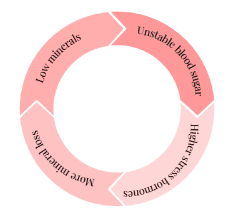
- Over time, this creates a cycle: low minerals → unstable blood sugar → higher stress hormones → even greater mineral loss. This is why many women feel wired, anxious, or exhausted when blood sugar is not well supported.
Signs Blood Sugar May Be Mineral-Driven
Blood sugar imbalance doesn’t always look dramatic. Common signs include:
- Feeling shaky, irritable, or anxious when hungry
- Craving sugar or carbs under stress
- Afternoon energy crashes
- Waking at night (especially 2–4 a.m.)
- Difficulty losing weight despite eating well
- Feeling better after eating—but only briefly
These are often signals that the body lacks the mineral support needed to maintain steady energy.
Why Diet Alone Isn’t Always Enough
Balanced meals are essential—but minerals determine how well the body responds to those meals. If minerals are depleted:
- Insulin signaling weakens
- Glucose uptake slows
- Stress hormones rise more easily
- The body struggles to maintain balance between meals
This is why two women can eat the same foods and have completely different blood sugar experiences.
Why Knowing Mineral Patterns Matters
Minerals work in relationships, not isolation. Supporting blood sugar effectively requires understanding:
- Which minerals are low
- Which are dominant
- How stress has shifted metabolic priorities
Without that insight, blood sugar support often becomes trial-and-error—sometimes making symptoms worse instead of better. Understanding mineral patterns allows support to be stabilizing, not stimulating. Blood sugar stability changes everything. When blood sugar is supported at a foundational level:
- Energy becomes more consistent
- Cravings decrease
- Mood stabilizes
- Hormones communicate more clearly
- The nervous system feels calmer
This creates a ripple effect throughout the body—especially for women navigating stress, hormonal shifts, or midlife changes.
The Takeaway
If blood sugar feels unpredictable or exhausting, the issue may not be what you’re eating—but whether your body has the minerals it needs to regulate glucose calmly and efficiently. Mineral balance helps blood sugar feel less fragile—and life feel more stable.